
 +1-442-325-3923




 Live Chat







Your shopping cart is currently empty.
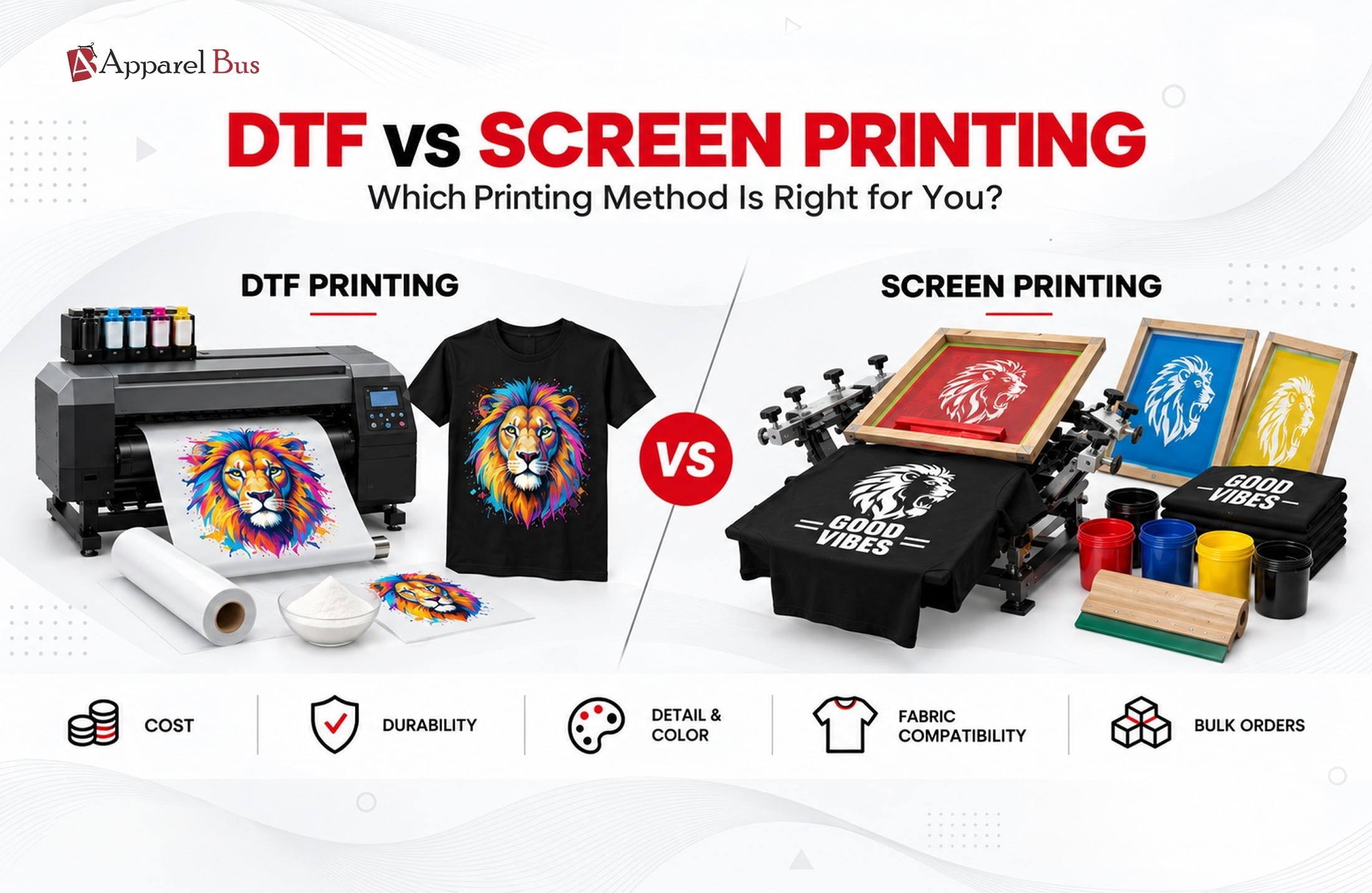
Table of Contents
- What Is DTF Printing?
- How Does DTF Printing Work?
- What Is Screen Printing?
- How Does Screen Printing Work?
- DTF vs Screen Printing: Quick Comparison
- DTF vs Screen Printing: Key Differences
- At What Quantity Does Screen Printing Become Cheaper?
- Durability
- Design Complexity
- Colors
- Fabrics and Material Options
- Print Feel and Finish
- Production Speed and Setup
- Style and Specialty Effects
- DTF vs Screen Printing: Which Is the Best Option for T‑Shirts?
- Let’s Understand it By Different Scenarios:
- When Both Options Make Sense
Share this Media




Published on 12 Oct 2026

By Apparelbus
DTF vs Screen Printing: Which Printing Method Is Right for You?
Choosing the right printing method can have a big impact on the cost, appearance, and durability of your custom apparel. So, when it comes to DTF vs screen printing, which option should you choose?
Both methods can produce high-quality prints on T‑shirts, hoodies, and other garments, but they work differently and suit different types of orders. DTF printing is often the better choice for small orders, detailed full-color artwork, gradients, and orders with multiple designs.
Screen printing usually makes more sense for larger quantities of the same design, especially when the artwork uses only a few colors.
Think about these questions before making a decision:
- Are you printing a small batch or ordering hundreds of shirts?
- Does your design contain several colors, gradients, or fine details?
- Are you looking for a soft print feel or a finish that can handle frequent wear and washing?
These factors can make one method a better fit than the other.
Let’s compare DTF and screen printing across cost, durability, colors, design detail, fabric compatibility, print feel, and production requirements. By the end, you’ll have a clear idea of which printing method fits your t‑shirt or custom apparel project.
What Is DTF Printing?
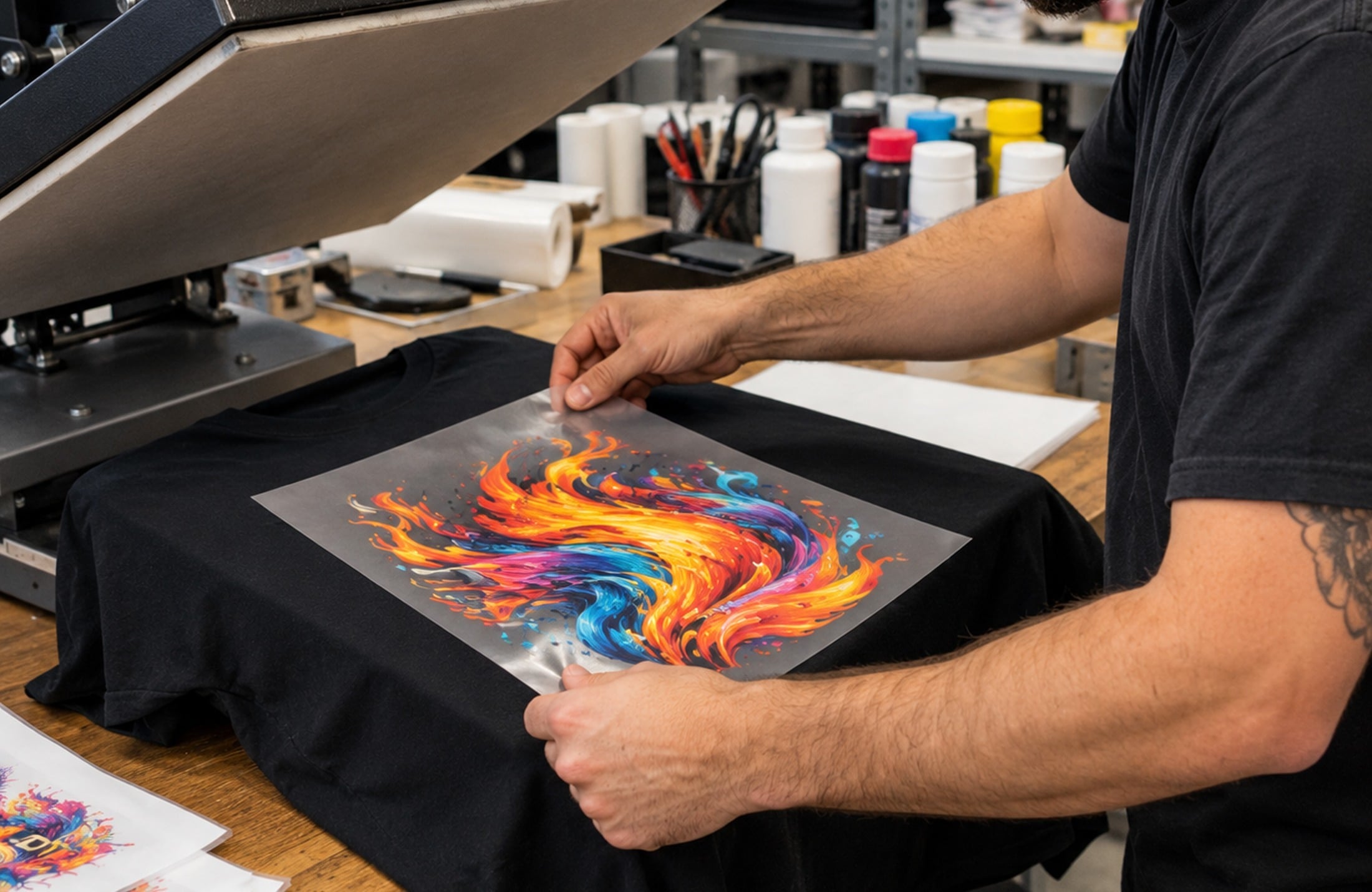
Direct‑to‑film, or DTF, printing is a digital method that transfers full‑color designs onto fabric using a printed film. Instead of building a stencil or screen, a DTF printer prints the artwork directly onto a specialized PET film using CMYK inks along with a layer of white ink underneath. Adhesive powder goes onto the printed film and cures under heat, and the finished transfer gets pressed onto the garment.
Because DTF prints digitally, it handles gradients, fine details, and photographic images with ease, which makes it a strong option for complex, multicolor artwork. DTF transfers work on cotton, polyester, and various blends, though results still depend on the fabric composition and how carefully the transfer is applied.
How Does DTF Printing Work?
- The designer prepares the digital artwork file.
- A DTF printer prints the design onto specialized film using CMYK and white ink.
- Adhesive powder gets applied to the wet ink, and the excess shakes off.
- The film runs through a curing process that melts the adhesive powder.
- The cured transfer gets heat‑pressed onto the garment, then peeled away to leave the design behind.
What Is Screen Printing?
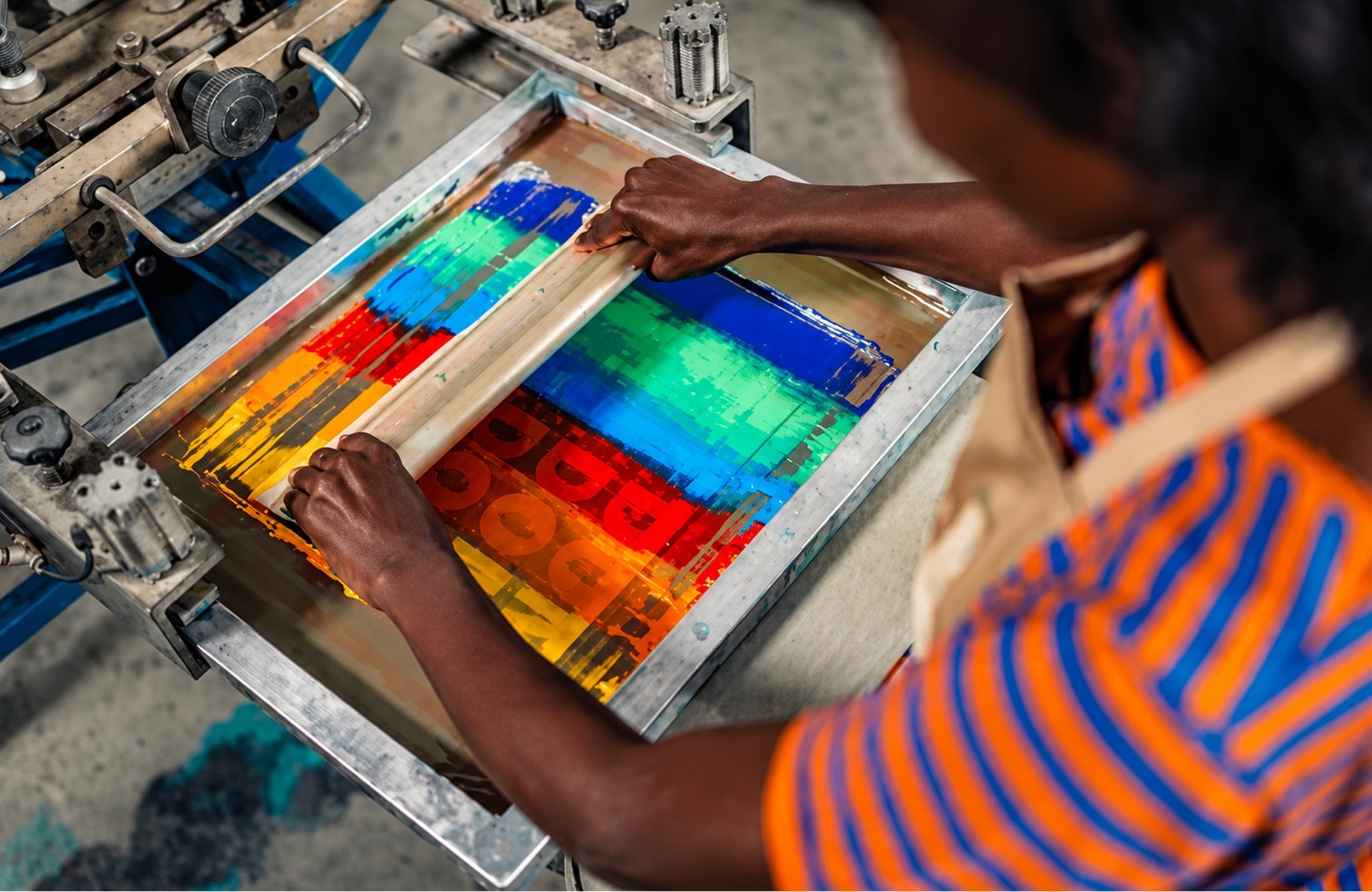
Traditional screen printing pushes ink through a mesh screen onto fabric. A stencil, created through a photo‑emulsion process, blocks certain areas of the screen so ink only passes through the open sections that form the design. Each color in the artwork typically needs its own screen, so multicolor designs require multiple screens and multiple print passes.
Screen printers commonly use plastisol ink, which sits on top of the fabric and cures with heat, or water‑based ink, which absorbs into the fibers for a softer feel. Even though it is one of the oldest garment decoration methods around, screen printing remains a popular choice for high‑volume production because of how efficient it becomes once the screens are ready.
How Does Screen Printing Work?
- The designer prepares and finalizes the artwork.
- The artwork is separated by color, since each color needs its own screen.
- A stencil is burned onto each screen using a photo‑emulsion process.
- Ink gets applied through each screen, one color at a time.
- The printed garment cures, usually with heat, to set the ink permanently.
DTF vs Screen Printing: Quick Comparison
| Factor | DTF Printing | Screen Printing |
| Best order size | Small to medium runs | Medium to large bulk runs |
| Setup | Minimal per design | Screen preparation required |
| Cost | Strong for smaller or mixed orders | Strong for large repeat orders |
| Colors | Full color artwork | Separate screen for each color |
| Detailed artwork | Excellent | Better for simpler artwork |
| Gradients | Excellent | More difficult |
| Photos | Suitable | More challenging |
| Cotton | Yes | Excellent |
| Polyester | Yes, with a suitable process and ink | Yes, with suitable inks |
| Blends | Yes | Yes, depending on the garment and ink |
| Dark garments | Yes | Yes, often with an underbase |
| Durability | Durable with proper application and care | Highly durable with proper application and cure |
| Print feel | Can have a slightly raised, film‑like feel | Depends on the ink and application |
| Specialty effects | More limited | Strong option for specialty inks |
| Customization | High flexibility | Better suited to repeat designs |
| Production setup | Faster | More preparation required |
DTF vs Screen Printing: Key Differences
DTF vs Screen Printing Cost
Cost is one of the biggest differences between the two methods, but there is no single price point where one method always becomes cheaper.
DTF has relatively little setup work. You do not need to prepare multiple screens before printing, so it can make financial sense for small orders, one-off garments, or orders containing several different designs.
Screen printing has more upfront work because screens must be prepared and artwork is separated by color. However, those setup costs are spread across the order. As the quantity increases, the cost per garment can drop significantly.
The number of colors also matters. A simple one- or two-color design can be very economical with screen printing at high volume. A detailed full-color design may make DTF more attractive because additional colors do not require additional screens.
At What Quantity Does Screen Printing Become Cheaper?
There is no universal break-even quantity for DTF and screen printing. The point at which screen printing becomes more economical depends on the printer's pricing, number of colors, print size, number of print locations, garment cost, and setup fees.
As a general rule, DTF tends to make more sense for smaller runs, while screen printing becomes increasingly attractive as you order more of the same design.
For example, ordering 25 shirts with a detailed, full-color graphic may favor DTF because there is little setup. Ordering 500 shirts with the same two-color logo can favor screen printing because the setup cost is distributed across hundreds of garments.
If you plan to reorder the same design regularly, screen printing can become even more attractive because the artwork and production setup can be reused.
Durability
Both methods can hold up well over many washes when they are produced correctly. Screen printing has a long track record for durability, particularly with plastisol ink applied at the right thickness and cured at the correct temperature.
DTF prints can also provide strong wash durability when the adhesive powder cures properly and the transfer is pressed at the right temperature and pressure. In both cases, proper curing and garment care matter more than the printing method itself when it comes to how long a design lasts.
Design Complexity
DTF has a clear edge here. Because it prints digitally, it reproduces fine details, small text, gradients, photographic images, and intricate illustrations without added cost or extra production steps.
Screen printing can reproduce detailed artwork too, but every additional color adds a new screen and a new pass, which increases both the cost and the production time for complex designs.
Colors
DTF handles full‑color, photorealistic designs in a single pass since it prints using CMYK plus white ink, similar to a standard digital printer.
Screen printing requires a separate screen for every color in the design, so costs and setup time rise with each additional color.
This makes DTF the stronger choice for multicolor or gradient‑heavy artwork, while screen printing remains a strong, economical option for designs with just one or two spot colors.
Fabrics and Material Options
Neither method works equally well on every textile, so it helps to think about fabric alongside the design itself. DTF transfers apply well to cotton, polyester, and cotton‑poly blends, and they generally handle dark garments without much extra prep.
Screen printing performs excellently on cotton, and it can print on polyester and blends too, though it may need specific ink formulations or an underbase layer on darker or synthetic fabrics to get a clean, opaque result.
Print Feel and Finish
DTF transfers sit on top of the fabric as a thin film, so large solid‑color areas can feel slightly heavier or more noticeable to the touch compared with the surrounding fabric.
Screen printing's feel depends heavily on the ink used: plastisol ink tends to sit on top of the fabric with a smooth, slightly raised finish, while water‑based ink soaks into the fibers for a softer, more breathable feel that is closer to the garment itself.
Production Speed and Setup
DTF's digital workflow skips screen preparation entirely, so a shop can move from finished artwork to a printed transfer fairly quickly, which suits small orders and frequent design changes.
Screen printing needs more time upfront for color separations and screen preparation, but once that setup is done, printing dozens or hundreds of identical garments becomes very efficient, since each screen can be reused pass after pass.
Style and Specialty Effects
Screen printing has an advantage when a project calls for puff ink, metallic finishes, or other specialty textures, since these effects rely on the way ink sits and cures on top of the fabric.
DTF's strength lies elsewhere: detailed graphics, full‑color artwork, and small custom runs where every shirt might carry a slightly different design. For jobs that fall outside either core method, printers sometimes turn to direct‑to‑garment printing or heat transfer as additional options worth comparing.
DTF vs Screen Printing: Which Is the Best Option for T‑Shirts?
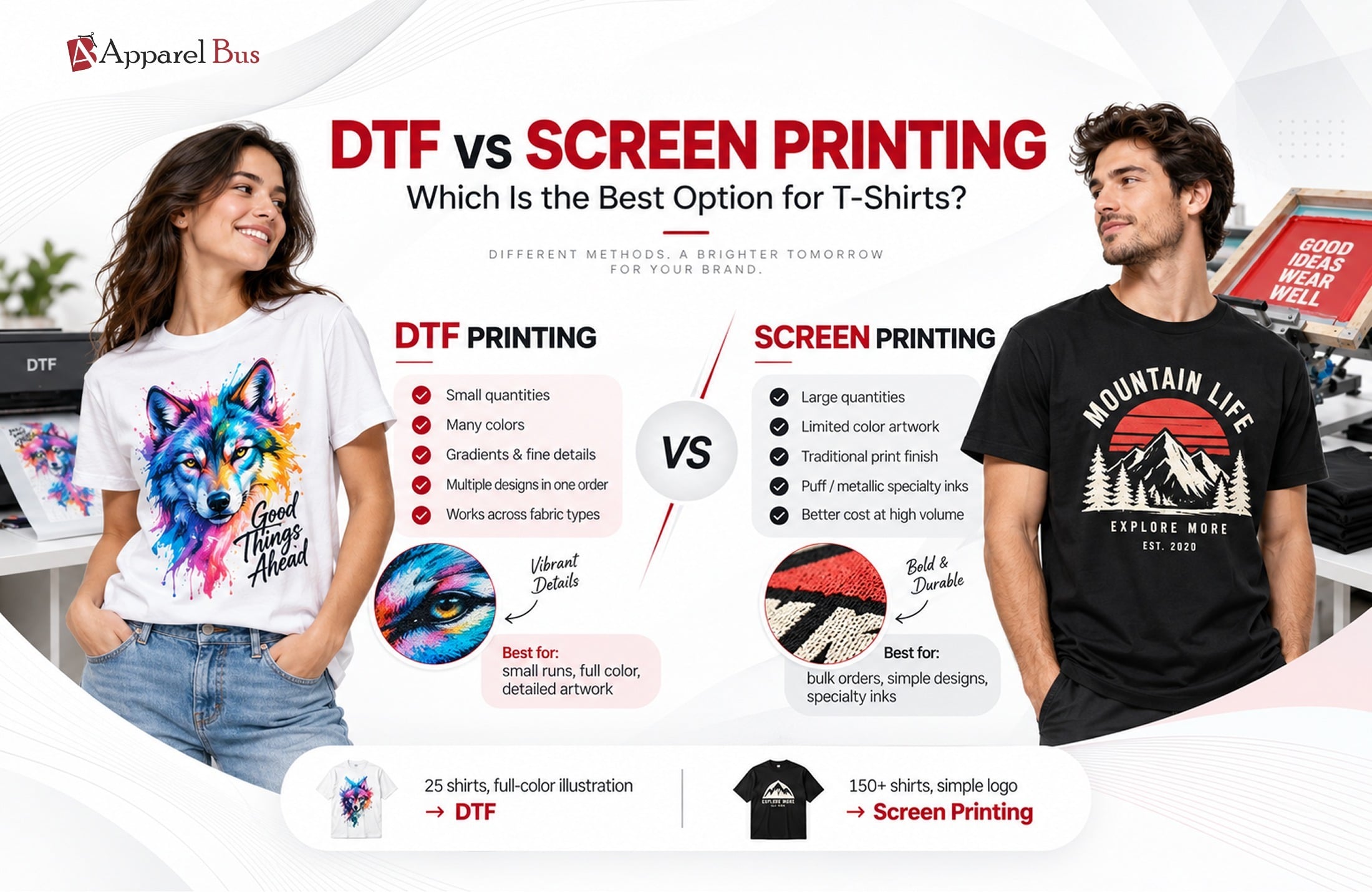
This is where the comparison actually becomes useful. Rather than picking one universal winner, match the method to the job in front of you.
Choose DTF for T‑Shirts When:
- You need a small quantity of shirts
- The design contains many colors
- The artwork includes gradients or fine details
- You need several different designs printed in the same order
- You are printing across different garment colors or fabric types
Choose Screen Printing for T‑Shirts When:
- You need a large quantity of the same design
- The artwork uses a limited number of colors
- You want a traditional, screen‑printed finish
- You need specialty ink effects like puff or metallic
- Cost per piece matters most at high volume
Let’s Understand it By Different Scenarios:
The easiest way to understand the difference is to look at typical orders.
25 shirts with a full‑color illustration: DTF is likely the more practical choice because the order is small and the artwork is complex.
150 shirts with a one‑color company logo: Screen printing may offer better value because the same simple design is repeated across a larger quantity.
40 shirts with different full‑color graphics: DTF can simplify production because each garment can carry different artwork without preparing a separate screen setup for every design.
500 event shirts with a two‑color logo: Screen printing is likely to make more sense because the large quantity spreads setup costs across the entire order.
These are general examples, not fixed pricing rules. Actual costs depend on the printer, garment, artwork, and order specifications.
When Both Options Make Sense
A print shop does not need to treat DTF and screen printing as competing technologies. Many businesses use both, choosing whichever method fits each job. Twenty custom T‑shirts with a detailed, full‑color graphic call for DTF, while five hundred event shirts carrying a simple two‑color logo make more sense with screen printing.
This job‑fit approach, rather than declaring one method the outright winner, tends to produce better results and better value across a mix of orders.
Share this Media
Leave us a comment